Compute core
Smartphone or tablet (iOS)
Runs the mobile app — the session control centre.
Neurofeedback · EEG · Adaptive environment
NeuroAsessment turns your brain's current state — focus and relaxation — into a living audiovisual environment. Train attention, memory and mindfulness through play.
Concept
NeuroAsessment is a device for cognitive rehabilitation and training. The Muse headband records EEG, the app interprets the state of your brain, and smart light and generative sound respond to it in real time.
Mobile app
A Flutter app for iOS and Android. It connects to Muse, the Philips Hue Bridge and the audio engine; it shows Focus and Calm in real time and offers ready-made training protocols.
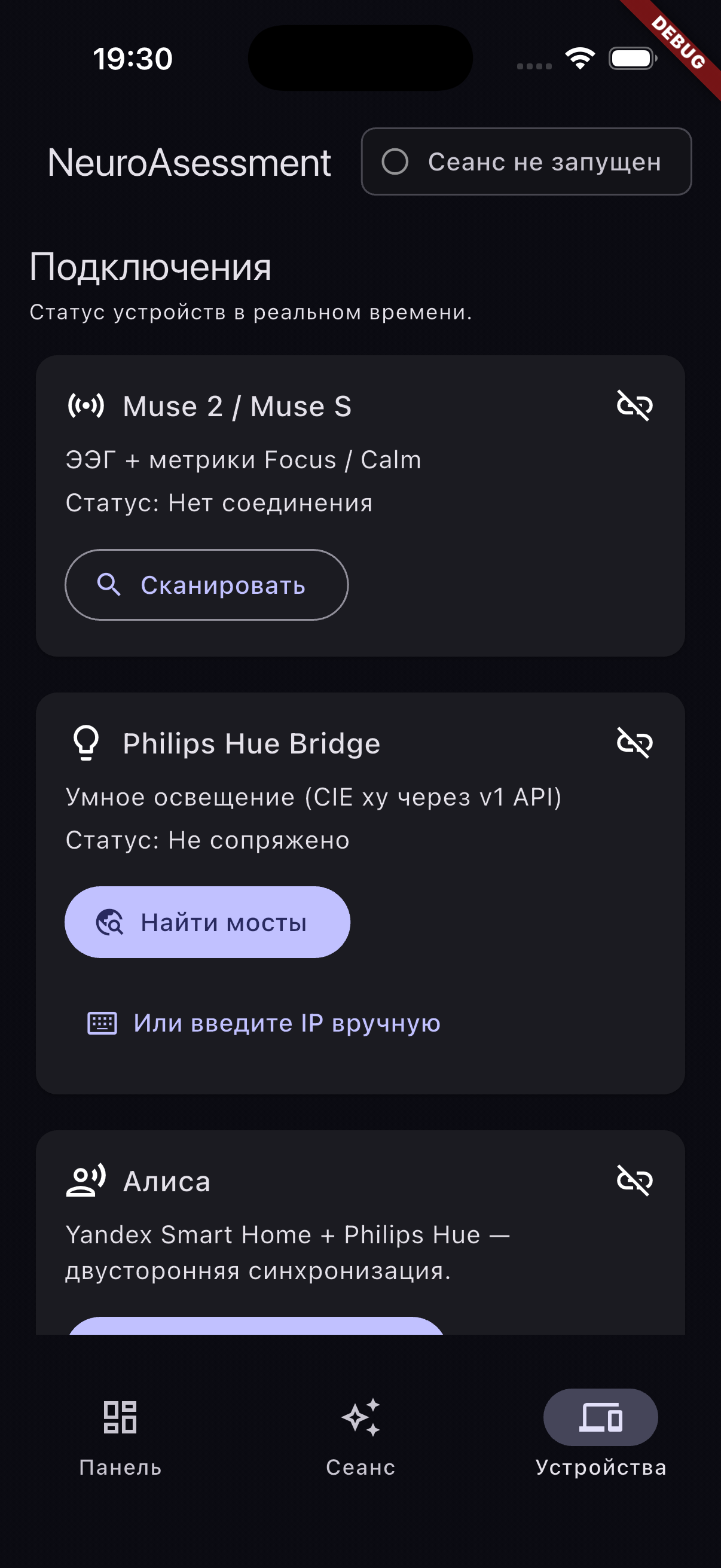
Muse 2 / Muse S and the Philips Hue Bridge: live status, headband scan, bridge auto-discovery or a manually typed IP. The Alice link comes up by itself once Hue is paired — it needs no card of its own.
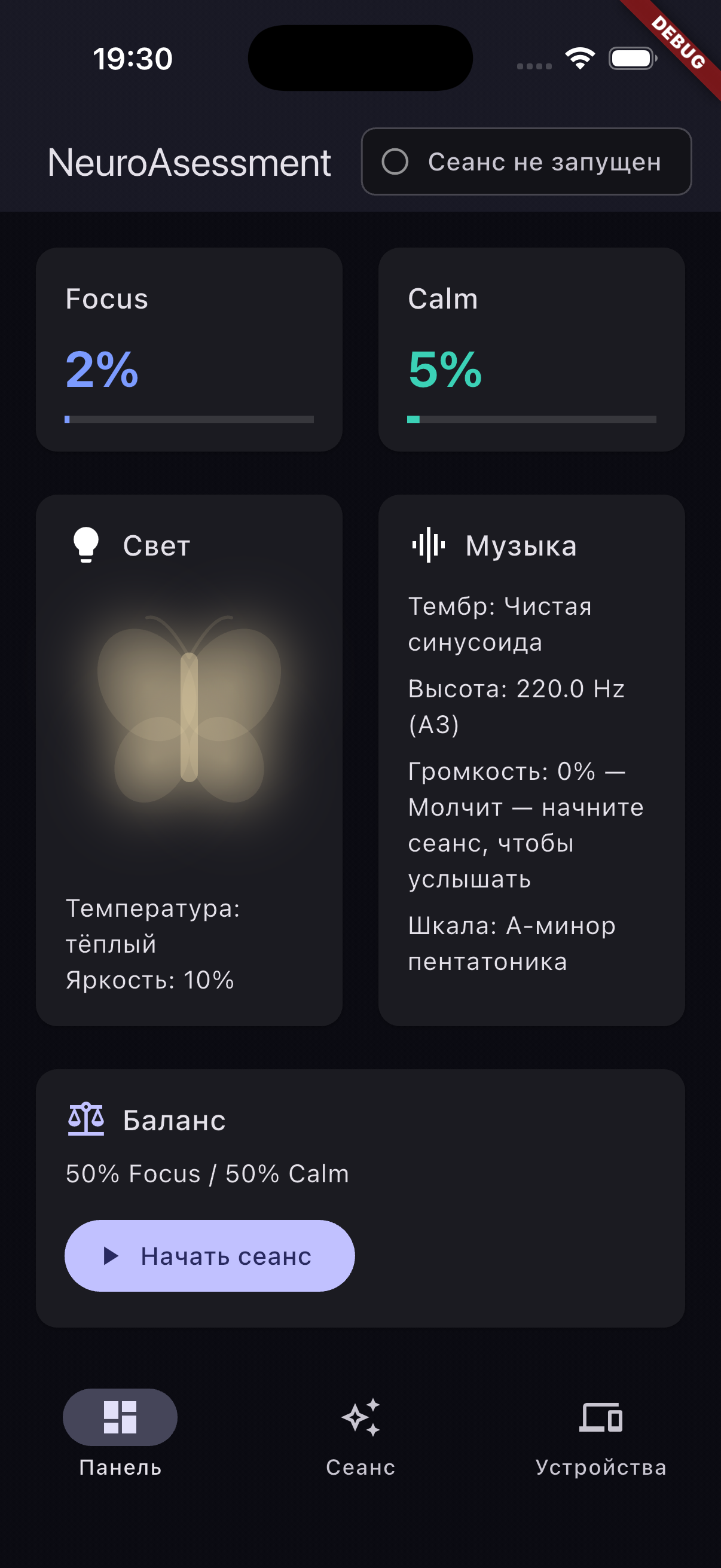
Focus and Calm as percentages, the butterfly light visualisation with temperature and brightness, Music — five voices, each on its own EEG band with its own percentage — and the active protocol.
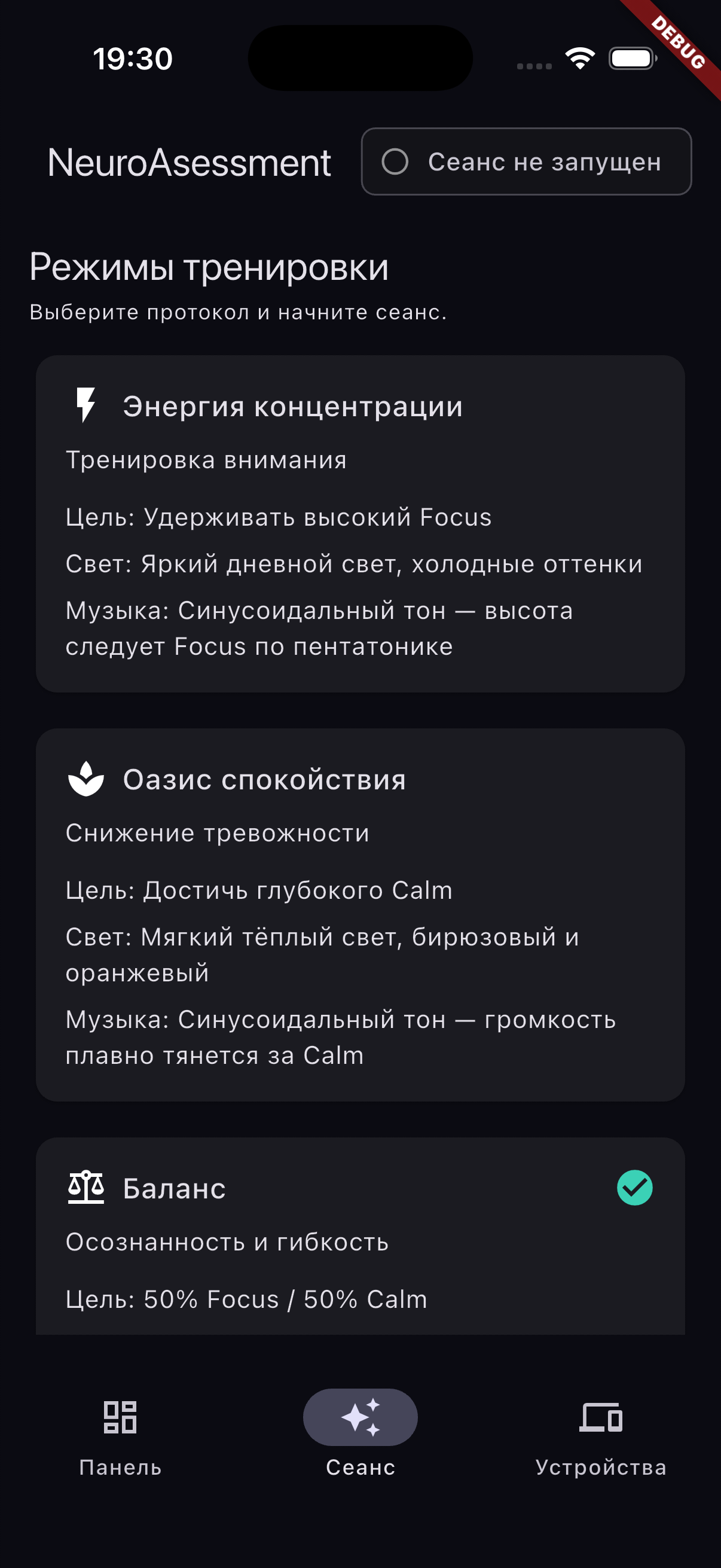
FocusScore / CalmScore sliders for working without a headband, a butterfly style toggle — one whole colour or split across the five Δθαβγ bands — and the language picker: English, Russian, Spanish.
How a session works
The headband measures bioelectrical activity and sends both raw data and computed metrics to the app.
Two values from 0–100%: FocusScore and CalmScore. Without a headband, ManualFocusCalmSource takes over — the sliders in the signal simulator.
SessionState goes to LightSink (Hue, CIE xy, throttle ≥1 s) and AudioSink — BandMusic maps five EEG bands onto five instruments (delta → Cello, theta → Strings, alpha → Harp, beta → Violin, gamma → Bells) using a minor pentatonic scale in every octave.
A cloud bridge links Yandex Smart Home and Hue in both directions — the lighting responds to your voice as well as your EEG.
Hardware components
Smartphone or tablet (iOS)
Runs the mobile app — the session control centre.
Muse 2 · Muse S
EEG capture. Metrics: Focus (β rhythm) and Calm (α rhythm), plus band powers for delta / theta / alpha / beta / gamma.
Philips Hue Bridge · Wi-Fi / BLE
Receives commands from the app and drives the smart bulbs.
Philips Hue Go · LIFX · Google Home
Smooth shifts of colour and brightness — a living atmosphere of light.
AVAudioEngine · AudioTrack · PCM 48 kHz
A native additive synth on iOS and Android. Five voices — Cello / Strings / Harp / Violin / Bells — one per EEG band; each voice's volume follows its band's power, and the notes follow a minor pentatonic scale.
OAuth · cloud bridge · two-way sync
A cloud adapter links the voice assistant to Hue. Session state is available to Alice's routines.
ManualFocusCalmSource · sliders
A test mode without the headband: set FocusScore and CalmScore by hand — the engine responds exactly as it does to EEG.
Flutter · neuro_muse · neuro_audio · http
BiofeedbackEngine + OutputRouter; local Dart plugins for the Muse SDK and the native synth.
Scenarios · Demo
The butterfly is your EEG spectrum, rendered in a single whole colour. Its silhouette is built from five tiers, gamma → delta from top to bottom: the upper tiers swell with Focus (β rhythm), the lower ones with Calm (α rhythm). Move the sliders and watch the outline flow.
Move each metric's intensity — the wing tiers respond with the same formula the simulator uses in the app.
Goal: hold Focus high.
Bright daylight, cool tones. The mix shifts up an octave; the fast bands come forward — Violin (beta) and Bells (gamma).
Goal: reach deep Calm.
Soft warm light, turquoise and orange. The mix drops an octave; the slow bands take the lead — Cello (delta), Strings (theta) and Harp (alpha).
Goal: 50% Focus / 50% Calm.
Clean white light, neutral tones. No octave shift, all five instruments weighted equally — whichever band dominates at that moment steps forward.
The science
Regular training in which a person sees the result of their own mental activity in real time makes it possible to consciously steer the brain's patterns of work. That leads to lasting improvements in cognitive function and emotional regulation.